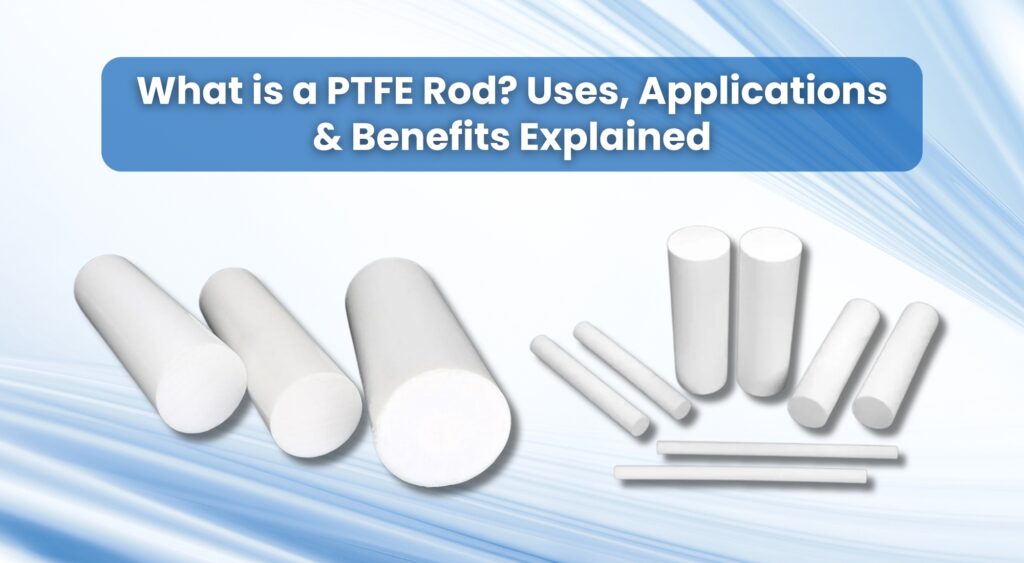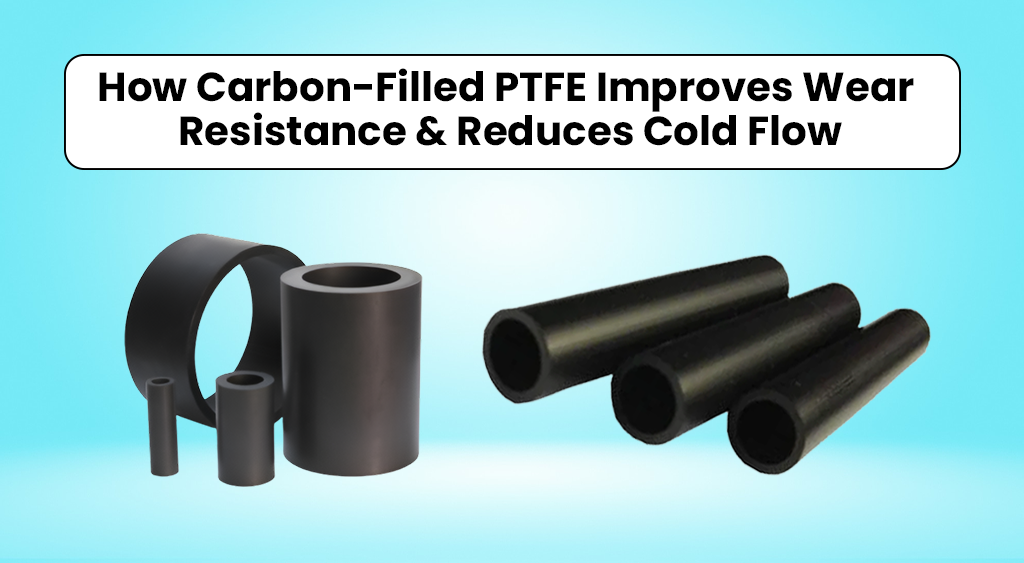
Polytetrafluoroethylene (PTFE), due to its exceptional properties like chemical resistance, wide range of temperature tolerance, and low friction ability, makes its application as a commonly used gasket and sealing agent. But with all these exception properties, virgin PTFE does have a few major weaknesses in the form of-
- Poor wear resistance under dynamic conditions and
- High cold flow (creep) under continuous pressure.
To overcome these limitations, manufacturers reinforce PTFE with fillers. Among the many options (glass fibre, bronze, graphite, molybdenum disulphide, etc.), carbon-filled PTFE (typically 15–35 % carbon fibre, carbon powder, or a blend of carbon + graphite) has become one of the most popular and effective compounds.
This article explains in detail how and why carbon-filled PTFE dramatically improves wear resistance and reduces cold flow while retaining most of the beneficial properties of virgin PTFE.
What Is Carbon-Filled PTFE?
As we know, virgin PTFE has its own limitations to overcome; carbon-filled PTFE is produced by adding 5-35% carbon in the form of graphite, powder, or carbon fibre into the virgin PTFE. This mixing ends up producing a stronger, denser PTFE structure with:
- Higher compressive strength
- Improved load-bearing capability
- Better heat dissipation
- Enhanced dimensional stability
It is commonly used in:
- Valve seats
- Piston rings
- Wear pads
- Bushings
- Mechanical seals
- Gaskets for high-pressure/static applications
Understanding the Weaknesses of Virgin PTFE
- A very low surface area with no stickiness results in very low friction
- Highly crystalline structure.
- Virgin PTFE has unbranched long molecular chains with a weak intermolecular(Van der Waals) force.
These characteristics produce the famous “non-stick and self-lubricating behaviour, but they also cause:
- Easy fibrillation and abrasive wear: PTFE smears and forms transfer films, but the transferred layer is soft and wears away quickly.
- High specific wear rate: typically 300–800 × 10⁻⁶ mm³/N·m (one of the worst among polymers).
- Cold flow: under compressive or shear stress, the crystallites slide past each other, leading to permanent deformation (creep rates 10–100 times higher than most engineering plastics).
Why Carbon is an Ideal Filler for PTFE
Carbon can be added in several forms:
- Carbon fibres (5–30 %) – high strength, high modulus
- Amorphous carbon/black (15–35 %) – lower cost, excellent thermal conductivity
- Graphite powder (5–15 %) – additional solid lubrication
- Hybrid carbon/graphite blends (e.g., 23 % carbon + 2 % graphite)
Key properties that make carbon outstanding:
| Property | Carbon Fiber | Carbon Powder | Graphite |
| Mohs hardness | ~4–5 | 1–2 | 1–2 |
| Thermal conductivity (W/m·K) | 50–120 | 10–30 | 100–400 |
| Tensile modulus (GPa) | 200–700 | – | – |
| Coefficient of friction (dry) | 0.15–0.25 | 0.12–0.20 | 0.08–0.15 |
| Compatibility with PTFE | Excellent | Excellent | Excellent |
Carbon fillers interrupt the weak van der Waals bonds, act as load-bearing elements, and significantly improve heat dissipation—three critical factors for wear and creep resistance.
How Carbon Filling Improves Wear Resistance
- Stronger and more dimensionally stable than pure PTFE
- Excellent for dynamic sealing and bearings
- Performs well in dry running conditions
- Less deformation compared to virgin PTFE
- Great for high-pressure systems
For more technical understanding:
4.1 Better Load Support
Carbon fibres or particles act as hard inclusions that carry the majority of the applied load. Instead of the soft PTFE matrix bearing the entire contact stress, the load is transferred to the much stiffer carbon phase. This reduces subsurface shear stress in the PTFE, preventing large-scale fibrillation. This property is best observed in gaskets and PTFE Sheets, which can support continuous load without wearing.
4.2 Disruption of Band Formation
Virgin PTFE fails by forming wide, continuous wear bands that peel off. Carbon fillers in virgin PTFE break these bands into much smaller debris, dramatically lowering the volume loss rate. Thus, carbon-filled PTFE are best suited for controlling the problem of volume loss during applications.
4.3 Improved Transfer Film
Although PTFE still forms a transfer film on the counterface, the presence of carbon particles makes the film thinner, more uniform, and far more adherent. The carbon acts as an anchoring point, preventing the film from being scraped away in large patches. This property of carbon generally enhances the performance of Virgin PTFE gaskets and bearings.
4.4 Heat Distribution
Friction generates heat that softens PTFE gaskets and other products. Carbon’s thermal conductivity is 50–400 times higher than virgin PTFE. Thus, rapidly conducts heat away from the contact zone and keeps the interface cooler. This property increases the shelf life of PTFE gaskets and valves.
For more details about why carbon-filled PTFE is preferred for higher performance over Virgin PTFE, dive deep by clicking on the link below. For a detailed understanding, please read our comprehensive comparison of Virgin and Carbon-Filled PTFE.
Quantitative Wear Improvement
Typical specific wear rates:
| Material | Specific Wear Rate (10⁻⁶ mm³/N·m) | Improvement vs Virgin |
| Virgin PTFE | 300–800 | 1× |
| 15 % Glass-filled PTFE | 20–50 | 10–15× |
| 25 % Carbon/Graphite-filled PTFE | 0.5–5 | 100–1000× |
60 % Bronze-filled PTFE | 3–10 | 50–200× |
25 % carbon-filled PTFE routinely achieves 200–1000 times better wear resistance than virgin material in dry sliding against steel.
5. How Carbon Filling Reduces Cold Flow (Creep)
Carbon-filled PTFE is simply the filling of virgin PTFE products like washers, gaskets and valves with carbon to introduce more strength, conductivity and durability without disturbing the original properties of PTFE.
For more technical understanding:
5.1 Restrict molecular mobility
Carbon fibres, by creating a 3-D network, physically block the sliding of PTFE material. The best product for this is Carbon-filled PTFE, which protects Virgin PTFE products from deformations.
5.2 Increase compression
Carbon filling drastically increases the compressibility of virgin PTFE. This compressibility also depends upon the percent mixing of carbon fillers in PTFE. To make it easy, we have listed compression in MPa for % of carbon filling
The elastic modulus of PTFE rises dramatically:
| Material | Compressive Modulus (MPa) |
| Virgin PTFE | 400–600 |
| 15 % Carbon fiber PTFE | 1000–1400 |
| 25 % Carbon/Graphite PTFE | 1200–1800 |
| 35 % Carbon fiber PTFE | 2000–2800 |
Higher modulus = lower strain for a given stress.
5.3 Reduce Creep
Due to continuous pressure, the issues of creep are common in virgin PTFE. To overcome this, we use carbon-filling. This controlled mixing of carbon fillers not only enhances the pressure handling capacity of the original product but also reduces the chances of creep and increases the shelf life of PTFE products.
24-hour creep at 23 °C, 14 MPa compressive load:
| Material | Creep Strain after 24 h (%) |
| Virgin PTFE | 6–10 % |
| 25 % Carbon-filled PTFE | 0.4–1.2 % |
| 35 % Carbon fiber PTFE | 0.2–0.6 % |
That is a 90–98 % reduction in cold flow.
6. Real-World Performance Data
| Application | Virgin PTFE Life | 25 % Carbon-Filled PTFE Life | Improvement |
| Compressor piston rings | 500–2000 h | 15,000–40,000 h | 10–20× |
| Hydraulic rod seals (dry) | <1000 cycles | >1,000,000 cycles | >1000× |
| Dry bearings (PV = 0.35 MPa·m/s) | 100–500 h | 8000–20,000 h | 50–100× |
| Ball valve seats | 6–18 months | 5–10 years | 5–10× |
7. Trade-offs and Limitations
While carbon-filled PTFE is superior in wear and creep, users must consider:
- Coefficient of friction increases from ~0.05–0.10 (virgin) to 0.12–0.25
- Thermal expansion coefficient rises (can cause tighter clearance issues)
- Electrical conductivity (becomes antistatic or conductive – beneficial in some cases, problematic if insulation is required)
- Slightly reduced chemical resistance in strong oxidizing acids at high temperatures.
Conclusion
To conclude, we can say carbon-filled PTFE is the most effective solution to solve the problem of wear resistance and creep without changing the core properties of virgin PTFE.
By incorporating 15–35 % carbon (fibres, powder, or carbon/graphite blends), manufacturers achieve:
- 100–1000× improvement in wear life
- 90–98 % reduction in creep deformation
- Ability to operate at higher PV limits in dry or marginally lubricated conditions
If you need the optimum balance of wear resistance, creep resistance, moderate friction, and good thermal conductivity in a fluoropolymer, contact Hindustan Polymer, the top PTFE Product Manufacturer.
Our carbon-filled PTFE is used because it is one of the most effective and proven solutions available today.
For almost any application where PTFE seals, bearings, bushings, or wear rings experience sliding contact and sustained load, our carbon-filled grades are the go-to compound and have been the industry standard for more than two decades.
FAQs (Frequently Asked Questions)
What is carbon-filled PTFE?
Carbon-filled PTFE is produced by adding 5-35% carbon in the form of graphite, powder, or carbon fibre into the virgin PTFE. This mixing ends up producing a stronger, denser PTFE structure.
What is cold flow (creep), and why does virgin PTFE suffer from it?
Cold flow is permanent deformation under continuous load at room temperature. Virgin PTFE can deform 6–10 % in 24 hours at 14 MPa due to the weak intermolecular (Van der Waals) force.
Carbon is used in which form to reduce wear and creep weakness of virgin PTFE?
Carbon is added in the form of graphite, powder, or carbon fibre into the virgin PTFE to reduce the problem of wear and creep. This mixing ends up producing a stronger, denser PTFE structure with higher compressive strength, lower friction, and better heat dispersion.
Is carbon-filled PTFE more expensive than virgin?
Yes, carbon-filled PTFE is 3-5 times more expensive than the regular virgin PTFE per kg, but its longer shelf life than virgin PTFE somehow justifies the higher price.
How much better is the wear resistance of carbon-filled PTFE?
Typically 100–1000 times better than virgin PTFE. 25 % carbon/graphite grades often achieve wear rates below 5 × 10⁻⁶ mm³/N·m.
Can carbon-filled PTFE be used in food-contact or medical applications?
Usually no. Carbon fillers are not FDA or EU 10/2011 approved for direct food contact (unlike virgin and some glass-filled grades).
Where is carbon-filled PTFE commonly used?
Carbon-filled PTFE is used in valve seats, bearings, bushings, piston rings, wear pads, seals, and high-pressure gaskets, ideal for dry, high-load applications.