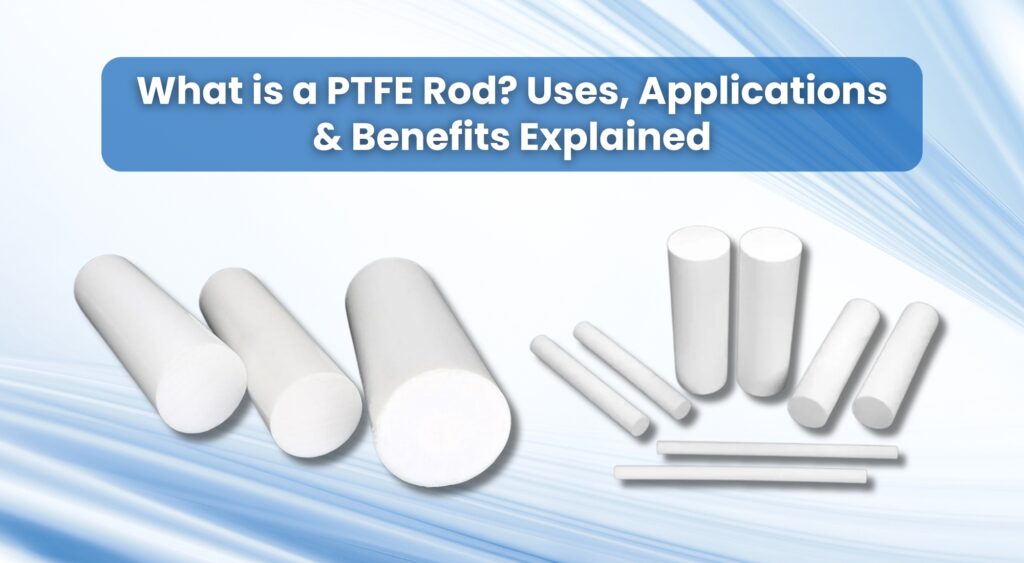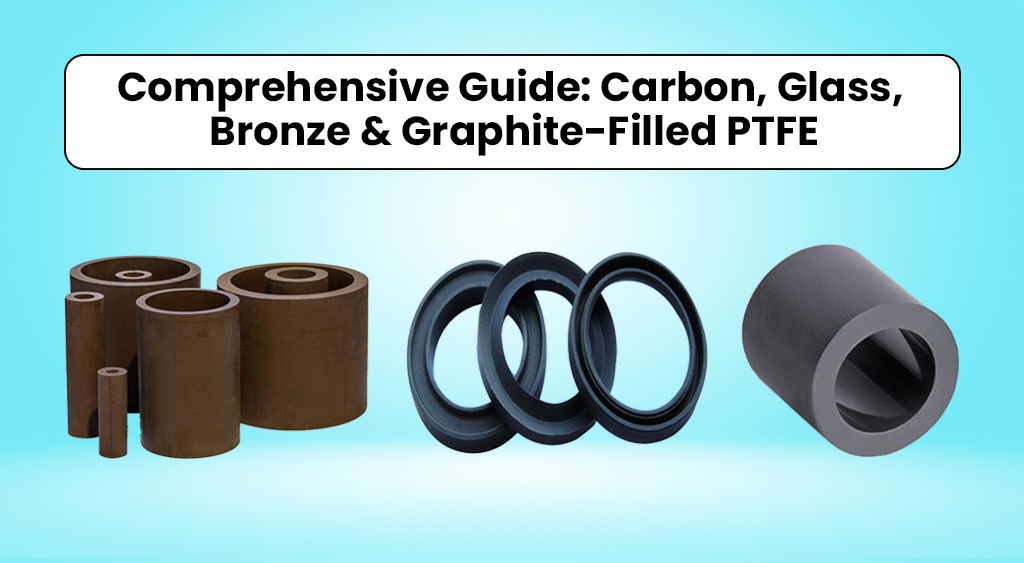
Polytetrafluoroethylene (PTFE), also famously known as Teflon, is one of the most commonly used gaskets and sealing agents. Though it has exceptional chemical resistance along with low friction and wide temperature tolerance but virgin PTFE does have some limitations in the form of poor wear resistance and high creep, etc.
To get rid of these limitations and improve PTFE’s mechanical and physical performance, manufacturers often add fillers like Carbon, Glass fibers, Bronze, and Graphite, etc. Each of these fillers has some additional properties that, when added to virgin PTFE, significantly increase its properties, making it suitable for specific industrial standards.
Here’s in this detailed comparison guide, we explore Carbon-Filled PTFE vs Glass-Filled PTFE, Bronze-Filled PTFE, and Graphite-Filled PTFE, analyzing their performance, benefits, limitations, and best-use applications.
Understanding Filled PTFE: Why Fillers Are Added
Fillers are added to PTFE to enhance characteristics such as:
- Wear resistance
- Creep resistance
- Load-bearing capacity
- Thermal conductivity
- Compressive strength
- Heat dissipation
- Dimensional stability
By combining PTFE with different fillers, engineers tailor materials for sealing, sliding, and friction-heavy environments.
1. Carbon-Filled PTFE
Carbon fillers (5%–35%) are added in powder or fiber form to boost PTFE’s strength. It is one of the most versatile reinforced PTFE materials.
Key Properties
- Excellent wear resistance — carbon drastically reduces surface abrasion.
- Low cold flow — high structural stability under constant pressure.
- Improved thermal conductivity — lower friction heat.
- High compressive strength — handles heavy loads.
- Low friction coefficient — suitable for dynamic applications.
- Good chemical resistance — suitable for most industrial chemicals.
Advantages
- Stronger and more dimensionally stable than pure PTFE
- Excellent for dynamic sealing and bearings
- Performs well in dry running conditions
- Less deformation compared to virgin PTFE
- Great for high-pressure systems
Limitations
- Slightly lower chemical inertness due to filler presence
- Black color may not suit food/pharma applications unless approved
- A conductive nature may not suit certain electrical insulation needs
Best Applications
- Mechanical shaft seals
- Wear pads & bushings
- Piston rings
- Valve seats
- Compressor rings
- Pump bearings
- High-pressure PTFE gaskets
2. Glass-Filled PTFE
Glass fiber is the most commonly used PTFE filler (15%–25%). It significantly improves mechanical strength but affects friction and wear behavior in certain conditions.
Key Properties
- Excellent creep resistance — much lower deformation under compression.
- Improved hardness and rigidity — stiffer than both virgin and carbon-filled PTFE.
- Good chemical resistance — except in hydrofluoric acid and alkaline environments.
- Stable at high temperatures — retains stiffness.
Advantages
- Outstanding dimensional stability
- Highly resistant to cold flow
- Better load-bearing capability than virgin PTFE
- Suitable for static and moderate dynamic applications
- Cost-effective compared to carbon- or bronze-filled grades
Limitations
- Higher friction coefficient
- Can wear mating metal surfaces (abrasive in sliding applications)
- Lower thermal conductivity
- Not ideal for dry running
Best Applications
- Valve seats and seals
- Structural PTFE components
- Electrical insulation (non-abrasive environments)
- Pump housings
- Static high-pressure gasket applications
- Chemical processing gaskets
3. Bronze-Filled PTFE
Bronze (40%–60%) is added to significantly strengthen PTFE for heavy-duty mechanical applications. Bronze-filled PTFE is usually brown or gold in appearance.
Key Properties
- High compressive strength — much stronger than carbon- or glass-filled PTFE.
- Excellent thermal conductivity — superior heat dissipation.
- Good wear resistance — handles repetitive motion well.
- Lower friction — beneficial for high-speed dynamic systems.
- Reduced cold flow — stable under load.
Advantages
- Highest mechanical strength among filled PTFE variants
- Good for high-speed & high-load bearing applications
- Withstands metal-to-metal contact conditions
- High surface durability
- Very long service life in industrial environments
Limitations
- Poor chemical resistance — reacts with oxidizing acids and chemicals
- Higher density and weight
- Not suitable for corrosive applications
- More expensive than glass-filled PTFE
Best Applications
- Bearings & bushings
- High-load piston rings
- Heavy-duty wear strips
- Rotary shaft seals
- Hydraulic component seals
- Industrial wear components
4. Graphite-Filled PTFE
Graphite (10%–30%) is added to lift PTFE’s self-lubricating properties, making it ideal for high-speed, low-drag applications.
Key Properties
- Low friction — one of the smoothest PTFE composites.
- Excellent wear resistance — especially in lubricated systems.
- Good thermal conductivity — reduces heat buildup.
- Enhanced load capacity — moderate to high.
- Stable dimensional performance — lower creep.
Advantages
- Very low friction under high speed
- Ideal for dynamic sealing & continuous sliding
- Performs exceptionally well with lubricants
- Less abrasive to mating surfaces compared to glass-filled PTFE
- Better high-temperature stability
Limitations
- Not ideal for dry running at extreme loads
- Cannot match carbon-filled PTFE in high-pressure sealing
- More expensive than standard PTFE grades
- Graphite reduces chemical inertness slightly
Best Applications
- Pump seals
- Valve packing rings
- Sliding bearings
- Compressor diaphragms
- Steam applications
- Dynamic O-ring backup rings
Detailed Comparison: Which PTFE Filler Is Best for Your Application?
| Properties | Best Fillers | Reasons |
| Wear Resistance & Long Service Life | Carbon-Filled PTFE and Bronze-Filled PTFE | Both can handle repetitive motion and resist abrasion effectively. |
| Low Friction | Graphite-Filled PTFE | Graphite’s natural lubrication reduces drag and heat. |
| High-Pressure / Load-Bearing System | Bronze-Filled PTFE | Bronze provides exceptional compressive strength. |
| Chemical Processing | Glass-Filled PTFE or Carbon-Filled PTFE | Bronze and graphite reduce chemical inertness. |
| High-Temperature | Graphite-Filled PTFE | Maintains lubrication and thermal stability. |
| High-Speed Dynamic Sealing | Carbon-Filled PTFE | Low friction, good wear resistance, and reduced cold flow. |
| Cost-Sensitive Industrial Applications | Glass-Filled PTFE | Offers excellent mechanical stability at a comparatively lower cost. |
| Cold Creep | Carbon-Filled PTFE | Creates a 3-D network that physically blocks the sliding of PTFE crystallites. |
Pros & Cons of Different Fillers
| PTFE Fillers | Pros | Cons |
| Carbon-filled PTFE | Best combination of strength, wear resistance, and low creep | Medium chemical compatibility; conductive nature can be a drawback |
| Glass-filled PTFE | Low creep, high stiffness, economical | Abrasive to metal surfaces; higher friction |
| Bronze-filled PTFE | Strongest mechanically; great for high loads | Poor chemical resistance; heavier |
| Graphite-filled PTFE | Lowest friction; great for sliding applications | Not ideal for extreme dry-running pressures |
Conclusion: Which Filled PTFE Should You Choose?
Choosing the right PTFE composite depends completely on its use. But to make it easier for you, we’ll note down some of the most dynamic properties along with their usage.
- Choose carbon-filled PTFE:- When you’re dealing with high-pressure rotating systems, dynamic sealing, wear, and bushing.
- Choose Glass-filled PTFE:- When you want structural stability along with static seals and gaskets, go for Glass-filled PTFE.
- Choose Bronz-filled PTFE:- if you’re planning to make gaskets, bearings that support heavy-duty bearings, piston rings, and high-load mechanical systems, bronze filling is best.
- Choose Graphite-Filled PTFE:- for high-speed, low-friction sliding surfaces and lubricated environments.
Any type of these fillers does increase the core properties of PTFE in some or other ways. So, by understanding these different properties, engineers can easily enhance the performance and increase the shelf life of virgin PTFE.
About Hindustan Polymers…
We do understand it is difficult to pick the best PTFE fillers even with all the details. Reasons can be anything from complex terminologies to different applicabilities.
That’s where Hindustanpolymers, a more than decade-old establishment with trust all around the industry, is a pioneer in providing excellent quality of PTFE materials, along with advanced engineered PTFE fillers like Carbon-Filled PTFE, Glass-Filled PTFE, Bronze-Filled PTFE, and Graphite-Filled PTFE, comes to your rescue.
Contact our experts to guide you in picking the best gasket material by connecting us on 9223365201/9773495031. Or email us at our official Email ID:- ask@hindustanpolymer.com
Frequently Asked Questions
What is the difference between Carbon-Filled and Glass-Filled PTFE?
Carbon-filled PTFE offers better wear resistance and low friction for dynamic applications, while glass-filled PTFE provides higher stiffness and creep resistance for static seals.
Which PTFE filler is best for high-pressure applications?
Bronze-filled PTFE is ideal for high-pressure systems due to its exceptional compressive strength and load-bearing capacity.
Can Graphite-Filled PTFE be used in dry-running applications?
Graphite-filled PTFE performs best in lubricated environments and may not be suitable for extreme dry-running under heavy loads.
Why are fillers added to PTFE?
Fillers enhance PTFE’s mechanical and thermal properties, including wear resistance, creep resistance, dimensional stability, and load-bearing capability.
Which PTFE filler is cost-effective for industrial gaskets?
Glass-filled PTFE is a cost-effective solution that offers high mechanical stability and excellent cold creep resistance for static gaskets and seals.