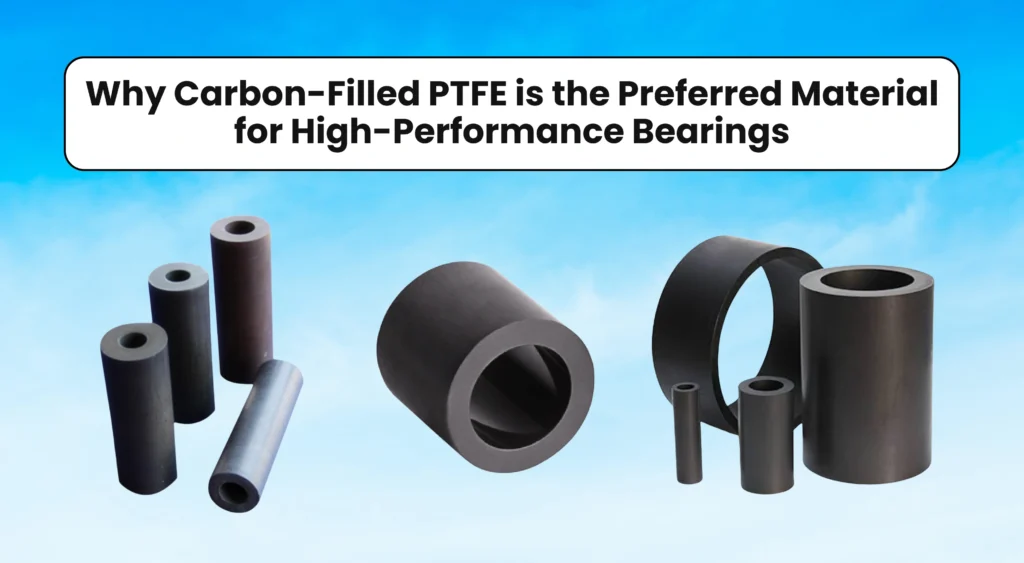
In the field of technical engineering, in machine and plant construction, choosing the correct bearing material is a deciding factor when it comes to performance, durability, and efficiency. Filler materials such as carbon-loaded PTFE (Polytetrafluoroethylene) have been widely used for high-performance applications. As the first TEF filled with carbon, CFP PTFE bearings exhibit an unusual balance of low coefficient of friction, good wear resistance, and excellent chemical stability to outperform almost all other conventional high-performance polymers when application conditions call for them.
If it’s aerospace, automotive, chemical processing, or industrial machinery, carbon-filled PTFE bearings have become the standard choice for engineers who need maximum performance in harsh environments.
I’ll cover what is so special about carbon-filled PTFE, how it compares to other materials, and why it’s frequently the desired material choice for high-performance bearings.
Understanding PTFE and Its Importance in Bearings
PTFE is a synthetic fluoropolymer known for its exceptional chemical resistance, non-stick nature, and low coefficient of friction. However, pure PTFE (also called virgin PTFE) has certain limitations, such as low wear resistance and high creep tendency (deformation under load).
To overcome these drawbacks, engineers add fillers such as carbon, glass, bronze, or graphite to PTFE. Among these, carbon-filled PTFE stands out due to its unique balance of mechanical and thermal properties.
Typically, carbon is added in concentrations of 15% to 25% by weight, improving the material’s load-bearing capacity, wear resistance, and thermal conductivity, all of which are crucial for high-performance bearing applications.
For an in-depth look at its properties, grades, design considerations, and industrial applications, read our Carbon-Filled PTFE Complete Guide to understand its performance benefits.
Key Properties of Carbon-Filled PTFE
Carbon-filled PTFE offers the ideal balance of PTFE and carbon, resulting in a product with excellent strength and stability. The most valuable bearing materials are listed as follows.
- Low coefficient of friction: Carbon-filled PTFE has the same non-stick properties of PTFE, but because it’s carbon-filled, it can be conductive and have static dissipative properties, as well as better wear or frictional parameters.
- This gives improved performance even when operating dry or in marginal lubrication, perfect for high-speed bearings and turbines as well as intermittently loaded systems.
- Better carrying capacity: The higher carbon content allows the material to withstand more static and dynamic loads without damaging deformation. It is particularly important for heavy-duty or high-load-bearing applications.
- Outstanding chemical resistance: The filled version is chemically inert, similar to neat PTFE, to virtually all chemicals except molten sodium and gaseous fluorine. This means it is ideal for corrosive environments such as chemical, oil/gas, and pharmaceutical industries.
- High thermal conductivity: Carbon increases PTFE’s ability to dissipate heat, reducing the risk of thermal buildup during continuous motion. Bearings made of carbon-filled PTFE maintain performance even in temperatures up to 260°C.
- Dimensional Stability: Carbon reduces PTFE’s thermal expansion rate, ensuring dimensional stability in fluctuating temperatures and high-pressure applications. This results in consistent bearing performance over time.
Read more: Virgin vs carbon-filled PTFE comparison
Why Bearings Need Advanced Materials
Bearings are common components that reduce friction in the movement and support of mechanisms. But they can break down under harsh conditions, high temperature, high-speed operation, or exposure to aggressive chemicals, as a result of wear and deformation.
- Bearings For High Performance Industries. They Need To:
- Operate without lubrication
- Resist chemical corrosion
- Handle heavy loads and thermal shock
- Maintain long service life
That’s where carbon-filled PTFE comes to rule all others.
Advantages of Carbon-Filled PTFE Bearings
Let’s explore the core advantages that make carbon-filled PTFE the preferred material for modern bearing systems.
- Great Self-Lubrication: The best thing about PTFE is its self-lubricating property; no external lubrication oil is required. The inclusion of carbon enhances this quality so that it remains in rotation even if running dry. This saves maintenance time and prevents contamination in sensitive applications such as food processing and pharmaceuticals.
- Extended Life: Carbon-filled PTFE bearings can run thousands of cycles with virtually zero wear, ideal for high-speed and continuous-duty applications.
- Performance at Any Temperature: Carbon-filled PTFE can work without difficulty in temperatures ranging from -200°C to +260°C, suitable for harsh conditions from cryogenic systems to high-heat turbines.
- Chemical and Environmental Resistance: Highly resistant to acids and degradation. This stability makes it commonly used in chemical plants and marine applications.
- Low Noise and Vibration: With low friction and damping properties, carbon-filled PTFE bearings provide smooth and silent operation—essential for precision instruments and aerospace systems.
Applications of Carbon-Filled PTFE Bearings
Carbon-filled PTFE bearings find applications across industries that demand reliability, endurance, and high performance under stress.
- Industrial Machinery: Used in pumps, compressors, and valves, they resist wear and corrosive chemicals even at high pressures.
- Aerospace and Aviation: Used in aircraft actuators, landing gear, and control systems for long-life, low-maintenance performance.
- Automotive: Used in suspension mounts, steering pivot mounts, and braking components for smooth motion and long life.
- Chemical Processing: Excellent for rotating equipment and seals handling brine, seawater, hydrochloric acid, and caustic solutions.
- Oil & Gas Sector: Ideal for offshore and refinery machinery exposed to high heat and aggressive chemicals.
- Renewable Energy: Used in wind turbines and solar trackers for low friction and long wear life with minimal maintenance.
Environmental and Economic Benefits
Carbon-filled PTFE bearings are environmentally friendly, requiring minimal maintenance and offering long service life. Because they require no oil or grease, they are a cleaner and more economical alternative to metal bearings. Their durability also results in lower replacement costs and reduced downtime.
Conclusion
Carbon-loaded PTFE has become established as one of the most reliable and efficient materials for high-performance bearings. It combines the self-lubricating properties of PTFE with the durability and wear resistance of carbon, making it ideal for many demanding industries.
With applications ranging from aerospace to automotive, chemical plants to green energy systems, carbon-filled PTFE bearings provide predictable low-friction performance, long life, and lower maintenance costs. For designers and engineers striving to create better-looking, more performing products, efficiency, durability, and reliability, carbon-filled PTFE remains the preferred material for modern high-performance bearing applications.
For more details on why Carbon-Filled PTFE is highly recommended for seals and industrial applications, read our guide on the Benefits of Carbon-Filled PTFE for Industrial Sealing
Frequently Asked Questions
What is the main advantage of carbon-filled PTFE in bearings?
It offers a perfect combination of low friction, high wear resistance, and thermal stability, ideal for high-load and high-temperature applications.
Can carbon-filled PTFE bearings be used without lubrication?
Yes, they are self-lubricating and can operate efficiently under dry conditions.
What percentage of carbon is used in carbon-filled PTFE?
Typically, between 15% to 25%, depending on the application’s load and temperature requirements.
Is carbon-filled PTFE suitable for food or medical applications?
No. Due to potential carbon contamination, it is not FDA-approved for food contact. Virgin or glass-filled PTFE should be used instead.
How long do carbon-filled PTFE bearings last?
Service life depends on operating conditions, but can be 5–10 times longer than pure PTFE bearings under similar environments.