In the modern industry, sealing substances are essential to ensure security, reliability, and efficiency from chemical factories to power-making facilities. Strong, durable seals offer excellent chemical resistance and have very low friction.
Sealing materials Sigraflex sealing materials are used to seal resiliently in all industrial sectors, from chemical plants and power generation plants. Strong, durable seals are more important now than ever. PTFE (Polytetrafluoroethylene) is one of the most common materials used and, because of its excellent resistance to chemicals and low friction, has become a long-time favorite.
But pure PTFE has limitations; it is soft, cold, flows under pressure, and lacks mechanical strength for heavy-duty applications.
What is Carbon-Filled PTFE?
Carbon-filled PTFE is a PTFE mixture prepared by mixing pure PTFE resin with carbon powder or graphite. The carbon amount is generally between 10 to 35 wt%, depending on the Hs contents.
This blend retains PTFE’s chemical inertness and non-stick nature, but provides better:
- Compressive strength
- Thermal conductivity
- Dimensional stability
- Wear resistance
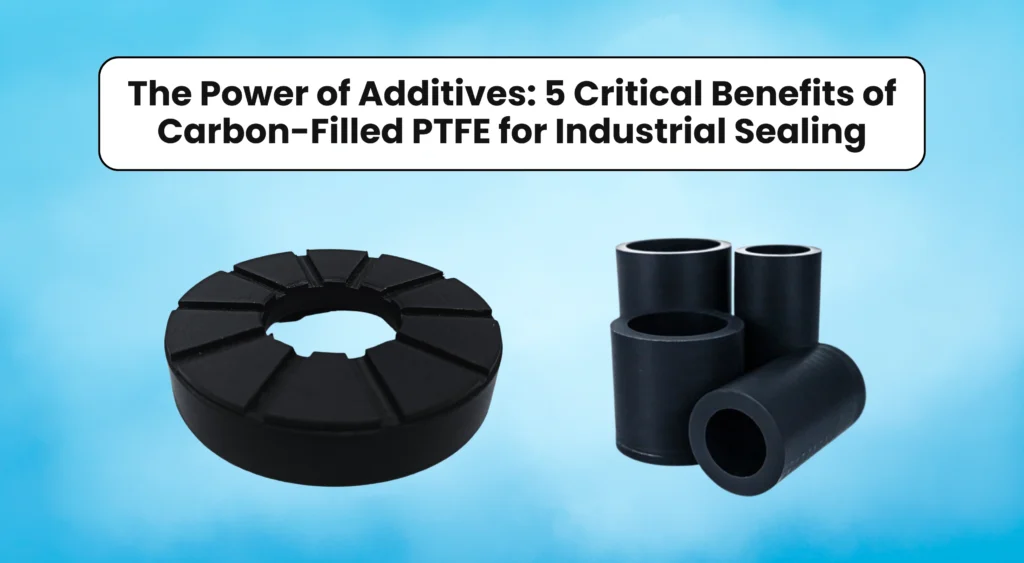
These improved properties provide reliable component performance for sealing in applications such as PTFE gaskets, valve seats, O-rings, and piston rings under severe conditions.
Why Add Carbon to PTFE?
Virgin PTFE will resist nearly all chemicals, but is subject to creep and deformation under load. Carbon serves as a reinforcing filler to support the drawbacks of PTFE.
- Here’s how carbon improves PTFE:
- Strengthens and stiffens to work under the highest pressure.
- Enhances heat dissipation, prevents thermal expansion.
- Improves wear-resistance and deformation reduction.
- Minimizes creep and cold flow under continuous stress.
- Maintains low friction for ease of sliding in dynamic sealing applications.
Essentially, carbon transforms PTFE from a soft, flexible polymer into a high-performance engineering material suitable for aggressive industrial environments.
For a more in-depth understanding of its composition, benefits, and engineering applications, visit our Complete Guide to Carbon-Filled PTFE.
1. Enhanced Wear and Creep Resistance
The material wear and creep constitute one of the major obstacles in the field of industrial sealing, particularly when seals are subjected to constant motion or varying pressures. Pure PTFE loses its properties after a while, which results in seal breakdown and leaking. Carbon-filled PTFE significantly reduces this problem.
How Carbon Helps:
- Carbon particles enhance the PTFE matrix, improving its load-bearing capacity.
- It provides superior resistance to abrasion and surface wear, even under dry-running conditions.
- The material retains its shape longer, ensuring tight and consistent sealing performance.
This makes carbon-filled PTFE a preferred choice for valve seats, compressor rings, and dynamic seals, where continuous friction and pressure variations occur.
2. Improved Thermal Conductivity and Heat Resistance
Another important property of carbon-filled PTFE is its high temperature resistance and performance under such conditions.
Although pure PTFE works up to 260°C, adding carbon increases thermal conductivity so the material dissipates heat more quickly.
Why It Matters to Sealing:
- High-speed or high-pressure sealing generates heat due to friction. Excess heat softens the seal and causes wear. Carbon fillers help dissipate heat and stabilize temperature.
- Carbon-filled PTFE gaskets and seals:
- Perform well in continuous high temperatures.
- Maintain mechanical stability without softening or melting.
- Provide repeatable sealing even with thermal cycling.
3. Superior Dimensional Stability Under Pressure
Industrial seal materials are commonly used under high compressive stress and pressure cycles. Soft materials deform and create leaks. Carbon-filled PTFE provides excellent dimensional stability.
How It Works:
- The carbon filler strengthens PTFE and increases elasticity.
- Reduces thermal expansion and contraction.
- Maintains shape for reliable sealing.
This stability is important in hydraulic actuators, pump seals, and flange gaskets.
4. Chemical and Corrosion Resistance
Carbon-filled PTFE retains PTFE’s exceptional chemical inertness, making it ideal for chemical processing, petrochemical, and pharmaceutical industries.
Chemical Resistance Benefits:
- Unaffected by aggressive acids, bases, and solvents.
- Suitable for corrosive gases and liquids.
- Does not react with most industrial fluids, ensuring long service life.
However, carbon slightly reduces electrical insulation, so it is not ideal for high-voltage applications.
5. Lower Friction and Better Sealing Efficiency
Sealing effectiveness depends on friction and wear behavior, especially in dynamic applications like rotary and reciprocating systems.
Carbon-filled PTFE maintains PTFE’s low-friction benefits while adding wear resistance and structural strength.
- Reduced wear between moving parts.
- Lower friction results in less energy usage.
- Self-lubricating, no external lubricants required.
This makes it perfect for shaft seals, piston rings, and valve seats.
Design Considerations for Carbon-Filled PTFE Seals
- Key factors when designing or selecting carbon-filled PTFE:
- Percentage of Carbon: Higher carbon (25–35%) increases wear resistance but reduces flexibility.
- Operating Temperature Range: Select materials that match system temperatures.
- Pressure Ratings: Choose filler percentages suited for pressure levels.
- Surface Finish: Smooth finishes reduce wear and friction.
- Environmental Conditions: Consider chemicals, moisture, and UV exposure.
When selected properly, carbon-filled PTFE seals can last 3–5 times longer than standard PTFE or rubber seals.
Conclusion
The inclusion of carbon in PTFE is a major advancement in material science. By increasing strength, wear life, and thermal performance, carbon-filled PTFE becomes the best choice for industrial sealing applications. Whether used in high-pressure gaskets, dynamic seals, valve parts, or piston rings, this material provides reliable performance even under extreme conditions.
In short, the power of additives, especially carbon, transforms PTFE from a simple polymer into a high-performance sealing material trusted worldwide. Learn more at Hindustan Polymer.